

Pakistan’s space program began with promising ambitions when the Space and Upper Atmosphere Research Commission (SUPARCO) was established in 1961, making Pakistan one of the earliest countries in Asia to invest in space research. Initial successes included launching sounding rockets, collaborating internationally, and building foundational infrastructure. However, subsequent decades saw intermittent development due to fluctuating government priorities and limited funding.
In contrast, Pakistan’s regional neighbors, notably India and China, pursued aggressive, consistent, and well-funded space programs. India’s ISRO has established itself as a global leader with significant milestones including Mars Orbiter Mission and the Chandrayaan lunar missions. China’s space capabilities have grown exponentially, making it a leading power in space exploration and satellite technology, culminating in their own orbital space station and ambitious lunar and Mars exploration missions.
For Pakistan, indigenous satellite technology represents not merely a symbol of national pride but also critical infrastructure. Communication satellites ensure secure and reliable telecommunications, facilitating economic growth and resilience. Intelligence and reconnaissance satellites enhance national security, providing crucial surveillance and situational awareness capabilities independent of external entities. Weather satellites significantly bolster disaster preparedness and agricultural management, vital for a country frequently affected by extreme weather events.
Most importantly, developing indigenous satellites fosters technological independence, reducing dependency on foreign services that might be subject to geopolitical pressures. This initiative also represents a strategic investment in human capital. It empowers Pakistani researchers, scientists, and engineers, creating high-tech jobs, and spurring innovation within the domestic technology sector.
Network and Communication Satellites
As of early 2025, Pakistan had approximately 116 million internet users, representing a rate of 45.7% of the total population. This indicates that around 137 million Pakistanis remained without internet access, with a significant portion residing in rural areas.
Satellite internet presents a viable alternative to traditional fiber-optic infrastructure, particularly for enhancing connectivity in Pakistan’s remote regions. Unlike fiber networks, which require extensive ground infrastructure and are susceptible to physical damage and power outages, satellite internet can deliver reliable service with minimal on-the-ground installations. This resilience is especially crucial for rural communities where establishing and maintaining fiber networks is often impractical due to challenging terrains and dispersed populations.
The economic implications of expanding internet access through satellite technology are substantial. Reliable internet connectivity enables rural entrepreneurs to engage in e-commerce, reaching broader markets and streamlining operations. It also opens up remote employment opportunities, allowing individuals to participate in the digital economy without migrating to urban centers. This can lead to more balanced economic development and alleviate urban overcrowding.
While international services like Starlink offer valuable short-term solutions, Pakistan should prioritize developing an indigenous satellite internet system to ensure the economic benefits remain within the internal economy. An indigenous system would complement existing infrastructure, providing essential redundancy alongside fiber-optic networks. This dual approach, combining satellite and fiber-optic technologies, enhances reliability, especially in rural and remote regions, thereby securing robust and resilient internet connectivity essential for future economic and social development.
Intelligence and Recon
Indigenous reconnaissance satellites play a critical role in modern warfare, offering nations the ability to independently gather, analyze, and act on real-time intelligence. The Ukraine-Russia war provides a striking case study in the effectiveness of space-based surveillance for asymmetric warfare. Despite facing a significantly larger military, Ukraine has used it’s own and NATO satellite intelligence to great effect. In 2022, Ukrainian citizens funded access to a synthetic aperture radar (SAR) satellite operated by the Finnish company ICEYE. Known as the “People’s Satellite,” it enabled Ukrainian forces to locate and track enemy movements. Within two days of its deployment, it identified over 60 Russian military assets. Over the next five months, it tracked 7,321 units of equipment and 360 military tents, proving indispensable in planning and executing precision strikes.
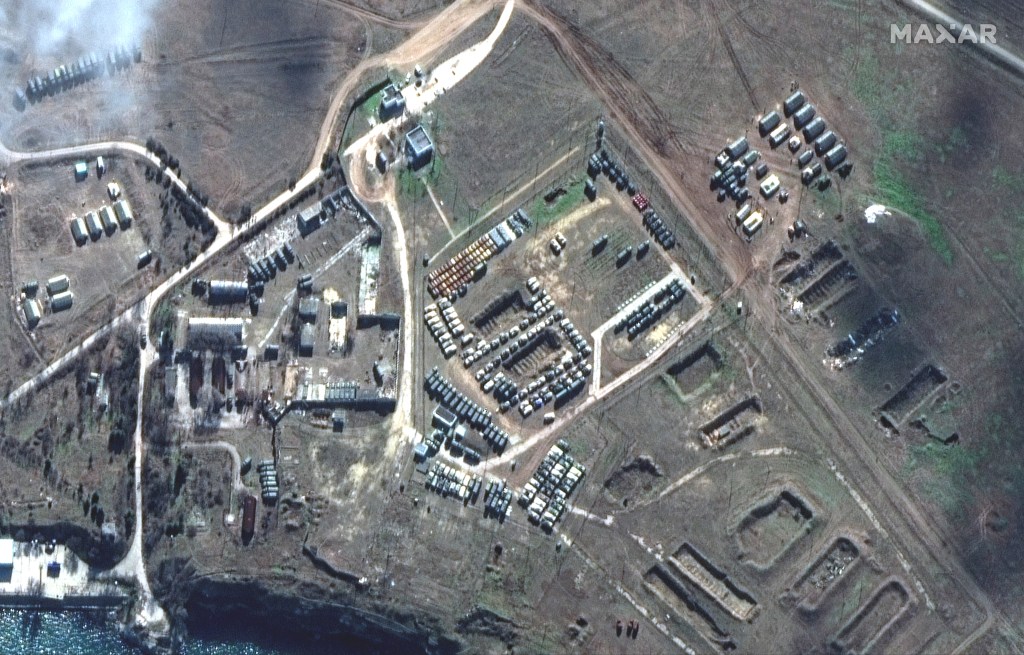
In 2022, a Maxar Satellite captures the Russian military buildup, providing Ukraine with valuable intelligence.
The United States also demonstrates the strategic necessity of space-based reconnaissance. Throughout the Cold War, satellites like the KH-7 GAMBIT provided high-resolution imagery to monitor Soviet missile installations and military infrastructure. In recent years, this capability has only grown more advanced. SpaceX is currently under a $1.8 billion contract with the U.S. National Reconnaissance Office (NRO) to build a new network of classified satellites capable of rapid, continuous surveillance across the globe.
Having indigenous capabilities means that intelligence gathering is not reliant on foreign powers, eliminating potential security gaps during conflicts or diplomatic tensions. For Pakistan, developing its own satellite reconnaissance infrastructure would enhance national security, allow for independent strategic planning, and provide an invaluable tool in both conventional and asymmetric defense scenarios.
Strategic Independence
Strategic independence in space is essential for ensuring uninterrupted access to critical infrastructure in times of conflict, sanctions, or global instability. For Pakistan, relying on foreign partners such as China for satellite launches or telemetry support introduces a single point of failure. If geopolitical interests diverge or external pressures are applied, access to these services may be restricted. This vulnerability was illustrated in 2021 when the European Space Agency suspended cooperation with Russia following the invasion of Ukraine, grounding several joint missions. Similarly, Iran’s satellite development has faced significant delays due to its reliance on external launch systems and imported components, many of which were restricted under sanctions.
Developing domestic launch capability is a necessary step for Pakistan to insulate its space assets from international disruptions. India’s Polar Satellite Launch Vehicle (PSLV), developed by ISRO, has completed over 50 successful launches and now positions India as a regional launch provider. The PSLV not only secures India’s own space missions but also generates revenue by launching foreign payloads, including from the US and Europe. In contrast, Pakistan currently lacks any operational launch vehicle, with its communication and observation satellites relying on launches from Chinese facilities. This limits mission flexibility and exposes critical infrastructure to foreign control.
Beyond launch independence, full vertical integration in the space industry, ranging from satellite design and manufacturing to ground station operations, is crucial for operational sovereignty. Countries like Israel and South Korea have invested heavily in developing self-sufficient space industries, enabling them to deploy defense and intelligence assets without relying on external assistance. In 2020, Israel launched its Ofek-16 reconnaissance satellite using its own Shavit rocket, underscoring its ability to deploy national security assets without foreign coordination.
The benefits extend beyond defense. A domestic space program creates high-skill employment, nurtures STEM education, and attracts private sector investment. The US space economy contributed over $211 billion to GDP in 2022, with the commercial satellite industry generating $113 billion alone. Even a fraction of this impact, localized in Pakistan, would help diversify the economy and reduce brain drain. Thousands of young engineers and researchers could be retained through meaningful, future-oriented work rather than seeking employment abroad.
Additionally, during conflict, embargo, or isolation, strategic assets such as satellites must remain operational. GPS-denied environments, electronic warfare, and embargoes have disrupted military operations across recent conflicts. Having hardened, locally operated systems, free from software backdoors or foreign access points, ensures that military communications, surveillance, and navigation continue uninterrupted.
Action Steps
- Establish a National Space Policy that mandates end-to-end indigenous capability development within defined timelines.
- Revamp and support for SUPARCO to transition from a research body to a full-spectrum space operator.
- Launch a dedicated national satellite launch vehicle program, focusing first on small satellite delivery to low Earth orbit.
- Develop secure, encrypted ground stations and telemetry systems under local control.
- Partner with universities and technical institutes to create a national aerospace talent pipeline.
- Invest in hardened, redundant satellite infrastructure for reconnaissance, communications, and navigation that can function in a denied environment.
By following these steps, Pakistan can achieve genuine strategic autonomy in space, unlocking both economic and defense dividends while securing national resilience for the decades ahead.